
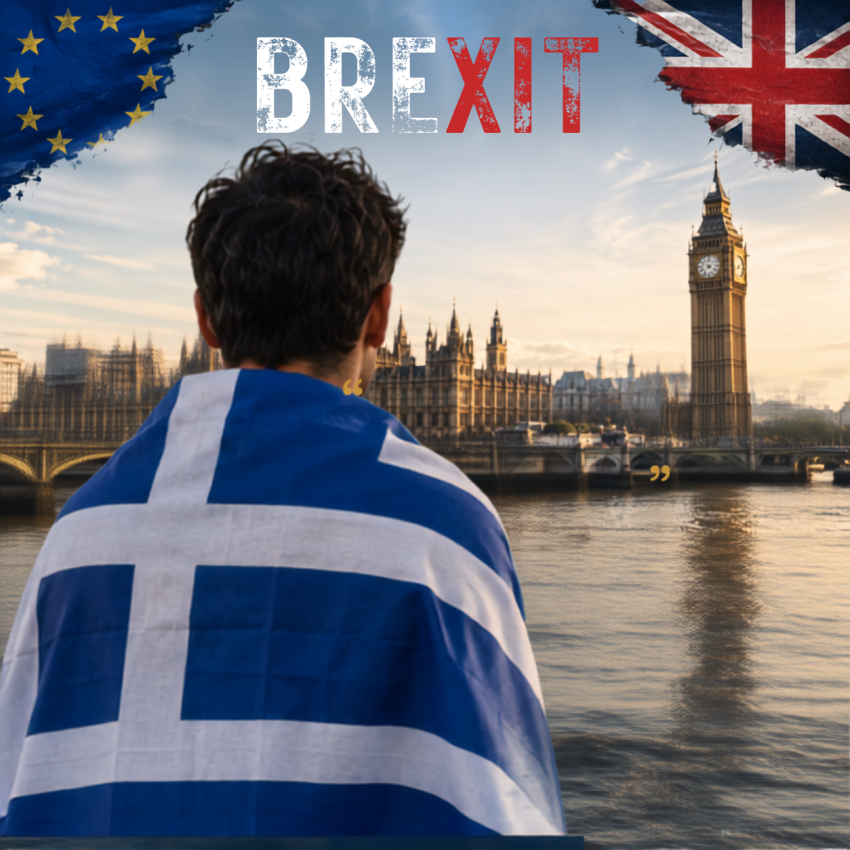
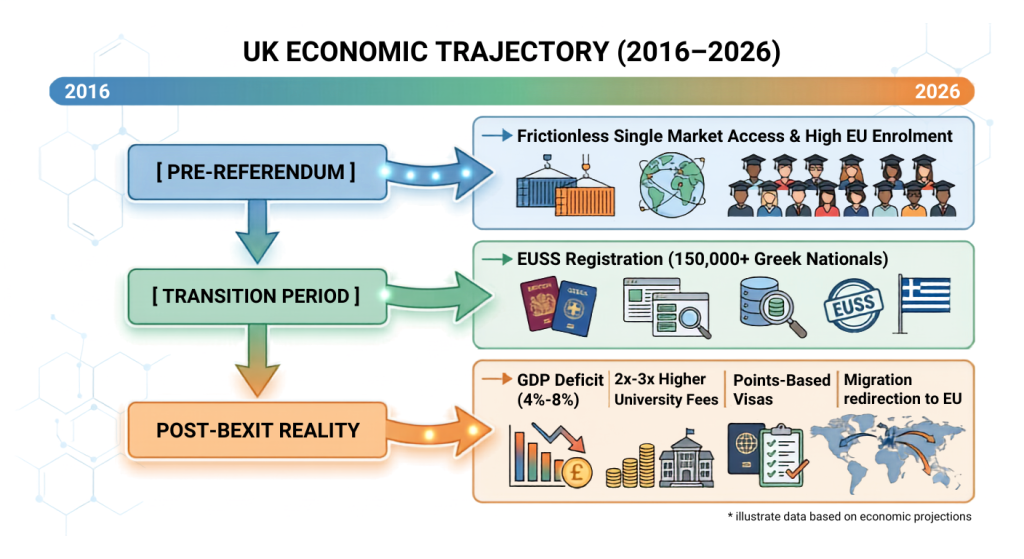
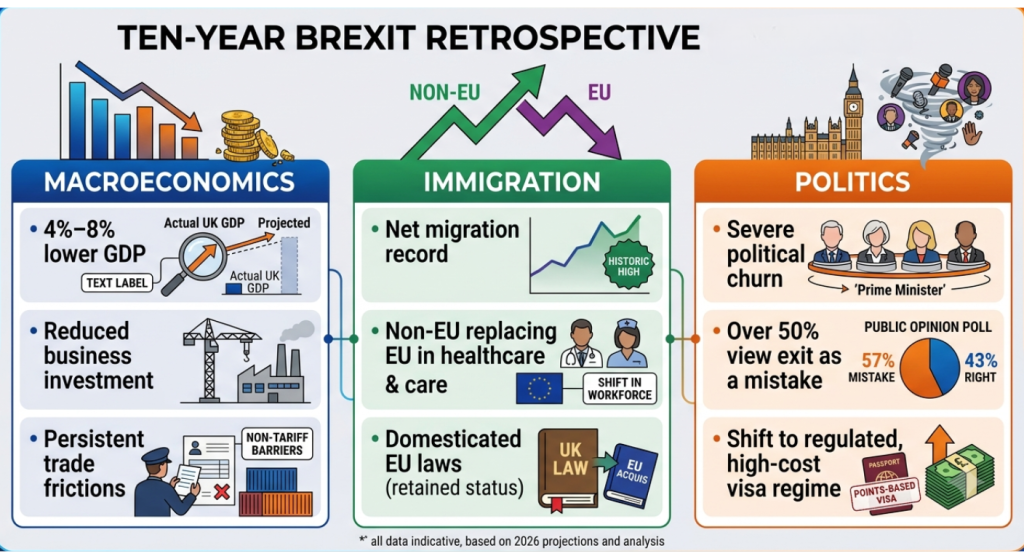
Ten years after the historic June 2016 referendum, consensus analysis demonstrates that Brexit did not trigger a sudden economic collapse, but it has acted as a persistent drag on the UK economy. A decade of empirical data confirms that Britain’s exit from the European Union fundamentally restructured its global posture, trade dynamics, domestic labour market, and socio-political landscape. Most economic studies indicate that UK GDP per capita is roughly 4% to 8% lower than it would have been had the nation remained inside the single market, accompanied by diminished business investment and severe, ongoing trade friction.
While macroeconomic figures summarise national productivity losses, the real story lies in the structural friction introduced into British economic and social systems. Ending free movement—the core pillar of EU integration – reconfigured the foreign-born workforce, restricted labour supply across vital sectors, and established a complex, high-cost visa apparatus.
To fully appreciate this ten-year milestone, one must examine both macro-level economic realities and specific micro-level human mobility patterns, particularly through the lens of long-standing diaspora communities such as the UK’s Greek population.
The Macroeconomic Footprint
1. Trade and Exports
Departure from the EU Customs Union and Single Market introduced an array of non-tariff barriers, border checks, and administrative red tape. Whilst the UK avoided catastrophic tariffs through the Trade and Cooperation Agreement (TCA), border inspections, rules-of-origin paperwork, and regulatory divergence significantly reduced both the variety and volume of goods exported to European markets. Small and medium-sized enterprises (SMEs) bore the brunt of this transition, with many opting out of exporting to the EU entirely due to prohibitive compliance costs.
2. Investment and Productivity
Business investment in the UK stalled significantly following the 2016 vote and has lagged behind comparable G7 economies ever since. This prolonged stagnation in capital expenditure directly stifled national productivity growth. UK businesses, forced to allocate capital towards Brexit compliance, legal auditing, and supply chain restructuring, diverted funds away from domestic research, development, and technological modernisation.
3. Growth and Economic Output
The immediate recession predicted by some campaign forecasts in 2016 failed to materialise; however, the long-term reality has proven to be a slow-burning erosion of capacity. Sub-par growth rates over the past decade mean that tax revenues remain squeezed, public services are under sustained funding pressure, and household incomes have stagnated compared to international peers.
The Greek Diaspora
The human and societal costs of post-Brexit border regimes are starkly illustrated by the Greek experience in the UK – a demographic that exemplifies how mobility restrictions alter human capital, corporate recruitment, and community identity.
1. Context: The “Brain Drain” Generation
Following the 2008 global financial crisis and the sovereign debt emergency that brought Greece to fiscal collapse, an estimated 500,000 Greeks emigrated between 2009 and 2019. Unlike mid-20th-century migration waves dominated by manual labour, this exodus was highly educated. Young doctors, engineers, researchers, computer scientists, and financial analysts departed Greece in large numbers.
Britain emerged as the primary destination for this skilled workforce due to three key factors:
- Deep Educational Ties: A long history of Greek students attending UK universities established active academic and professional networks.
- Language Proficiency: Widespread English-language fluency among young Greeks significantly lowered barriers to integration.
- Flexible Labour Markets: The City of London, the National Health Service (NHS), and Russell Group universities offered rapid career progression in contrast to Greece’s austerity-bound public and private sectors.
Greek medical professionals quickly populated NHS hospital wards, academics became one of the largest non-British EU faculty contingents in higher education, and quantitative analysts filled key roles across London’s financial district. By the time the UK launched the EU Settlement Scheme (EUSS), over 150,000 Greek nationals had applied for Settled or Pre-Settled status.
2. The Legal Paradigm Shift
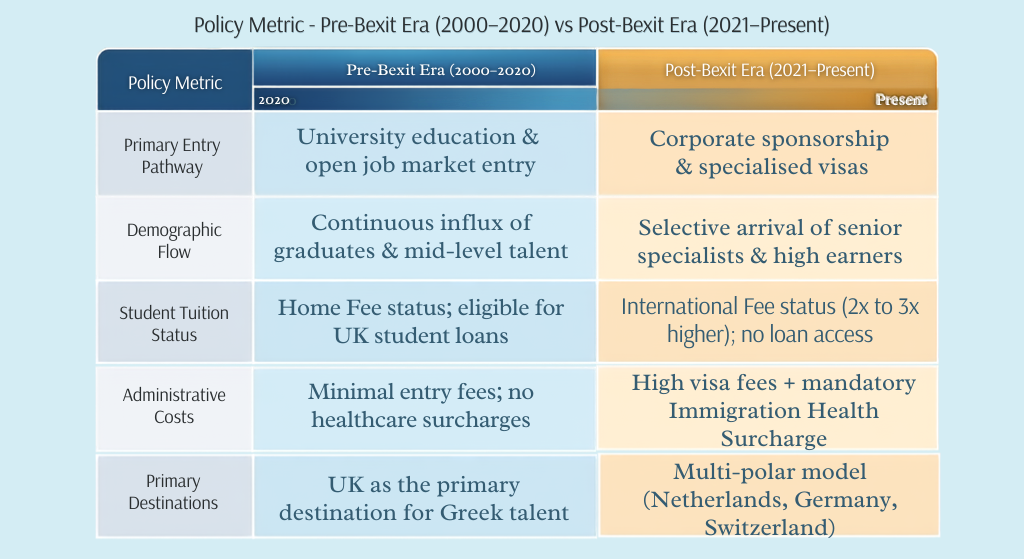
The implementation of the UK points-based immigration system in January 2021 dismantled this open-ended corridor. EU citizens lost their automatic right to live, work, and study in the UK, bringing them under administrative constraints previously reserved for non-EU foreign nationals.
3. Structural Impacts on Diaspora Sectors
Higher Education Pipeline Disruption
The most dramatic impact occurred in academia. Prior to 2021, Greek undergraduates paid identical “Home” tuition fees as domestic British students and held access to UK student loans. Reclassification to international student status doubled or tripled tuition costs, whilst the removal of loan eligibility mandated upfront self-funding. Higher Education Statistics Agency (HESA) data subsequently showed one of the steepest enrolment drops among Greek students compared to all other EU member states, permanently narrowing the incoming talent pipeline.
Corporate and Services Friction
Whilst major financial institutions and NHS trusts retain the capital to sponsor Skilled Worker Visas for senior specialists, entry-level and mid-tier roles have largely closed to foreign-born candidates without existing work authorisation. SMEs in specialised engineering, tech, and architecture frequently pass on hiring non-resident Greeks to avoid Home Office sponsorship paperwork and fees.
Similarly, Greek hospitality ventures, food importers, and cultural enterprises – reliant on short-term EU labour – faced severe staffing shortages due to visa salary thresholds, forcing many to contract operational hours or raise prices.
Alternative Hubs and the “Brain Gain” Reverse Flow
The restrictive post-Brexit UK market accelerated two parallel trends in continental Europe and Greece:
1. The Rise of European Competitors
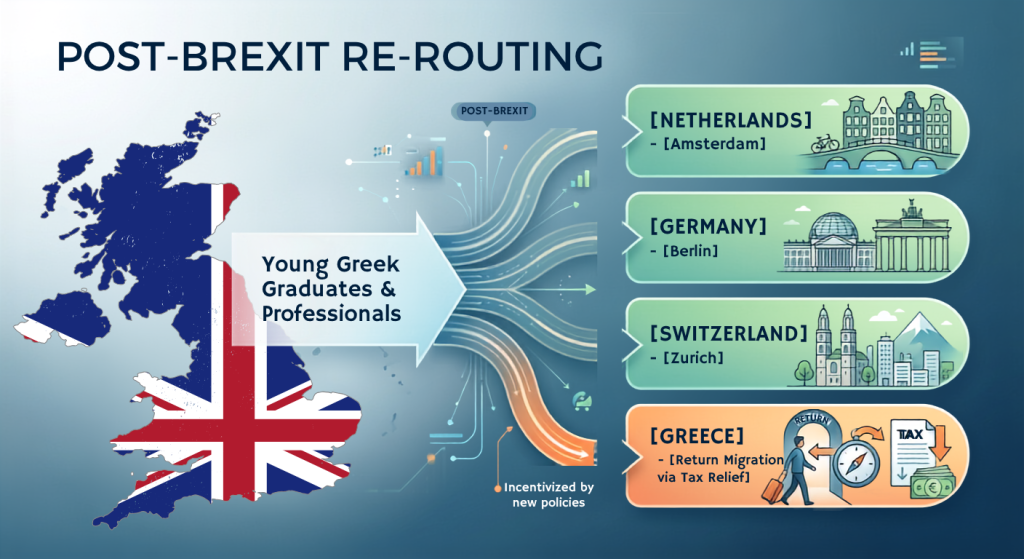
Ambitious young Greeks have increasingly redirected their mobility towards continental European hubs that operate extensively in English. Cities like Amsterdam, Berlin, Dublin, Copenhagen, and Zurich present clear comparative advantages:
- Unrestricted access under EU freedom of movement laws.
- Elimination of visa fees, sponsorship mandates, and healthcare surcharges.
- Dynamic tech sectors and heavily subsidised university tuition.
As a result, London’s decades-long position as the primary foreign hub for Greek graduates has fragmented into a multi-polar European distribution.
2. Economic Recovery in Greece and Tax Incentives
Simultaneously, Greece’s broader economic recovery over the past decade transformed domestic prospects. Sustained GDP growth, infrastructure modernisations, and large-scale foreign direct investment created viable local career opportunities. To capitalise on this, the Greek government introduced targeted measures to draw skilled labour back:
- 50% Income Tax Exemption: A seven-year tax relief program for professionals and self-employed individuals relocating their tax residence back to Greece.
- Remote Work Flexibility: Expanding remote options enabled many UK-settled Greeks to retain international roles whilst living in Greece.
- Regional Innovation Hubs: Investment in technology infrastructure across Athens and Thessaloniki established high-value positions that did not exist during the sovereign debt crisis.
For many who relocated to the UK between 2010 and 2015, Brexit acted as the catalyst to end their British tenure, driving a notable return flow of human capital to Greece.
Immigration, Politics, and Public Opinion
Beyond structural economic effects and diaspora realignments, the broader societal implications of Brexit over the past decade reflect profound political transformation across the UK.
1. Migration Shifts and Border Control
Whilst ending free movement curtailed European migration, overall UK net migration climbed to historic highs over the decade following the vote. To address acute labour shortages in healthcare, social care, and services, successive UK administrations expanded non-EU recruitment. Consequently, migration shifted from predominantly European, low-friction movement to heavily regulated international immigration from non-EU nations.
On border control, sovereignty over domestic lawmaking was formally reclaimed. However, rather than undergoing radical deregulation, much of the pre-existing body of EU regulation was simply domesticated into UK statutes to maintain operational continuity and prevent legal ambiguity.
2. Political Instability and Public Sentiment
The decade following the 2016 vote was marked by severe political instability, characterised by frequent changes in government leadership, parliamentary deadlocks, and persistent policy adjustments.
Ten years post-referendum, public sentiment reflects broad disappointment with how the departure was executed:
Economic Realisation: Frustration is fueled by the absence of promised economic windfalls, alongside tangible cost-of-living pressures and visible staffing shortages across public infrastructure.
Polling Realities: Clear majorities in recent surveys reflect public disappointment, with over half of the population viewing the departure as a mistake.
A Stratified Future
A decade after the 2016 referendum, the evidence confirms that Brexit reshaped the British economy not through a single catastrophic event, but through a steady, long-term reduction in potential growth, trade capacity, and international competitiveness.
For international talent – exemplified by the Greek diaspora – the UK has shifted from an open, low-friction market into a selective, highly regulated space. Britain remains an important hub for settled EU nationals anchored by the EUSS. However, the era of effortless mobility – where a graduate could move to London and build a career without institutional friction – has ended, replaced by strict visa thresholds, complex sponsorship rules, and a competitive landscape spanning continental Europe.