Greeks in UK
Menu
  • Home
  • Travel & Holidays
    • Travel Offers
    • Travel Inspirations
    • Uncover the beauty of Britain
    • Sports Gataways
    • Request a Personalised Travel Quote
  • Viewpoints
Menu

Category: Viewpoints

Issues, stories, and viewpoints defining life for Greeks in the UK. We deliver timely analysis, opinion pieces, and articles that bridge major news events with a personal perspective. Discover how local developments directly shape our community’s everyday reality, professional choices, and cultural identity abroad – combining reliable information, shared experiences, and authentic insight into the modern diaspora experience.

Is the UK Still Worth It for Greek Professionals?

Posted on 3 September 20266 August 2026 by Editor

For decades, the path from Athens or Thessaloniki to London, Manchester, or Edinburgh was viewed as the ultimate professional upgrade. Driven out by the financial crisis, successive waves of highly educated Greek doctors, software engineers, academics, and corporate strategists sought refuge in the UK’s dynamic economy. They traded Mediterranean sunshine for professional recognition, meritocracy, and salaries that allowed for real savings.

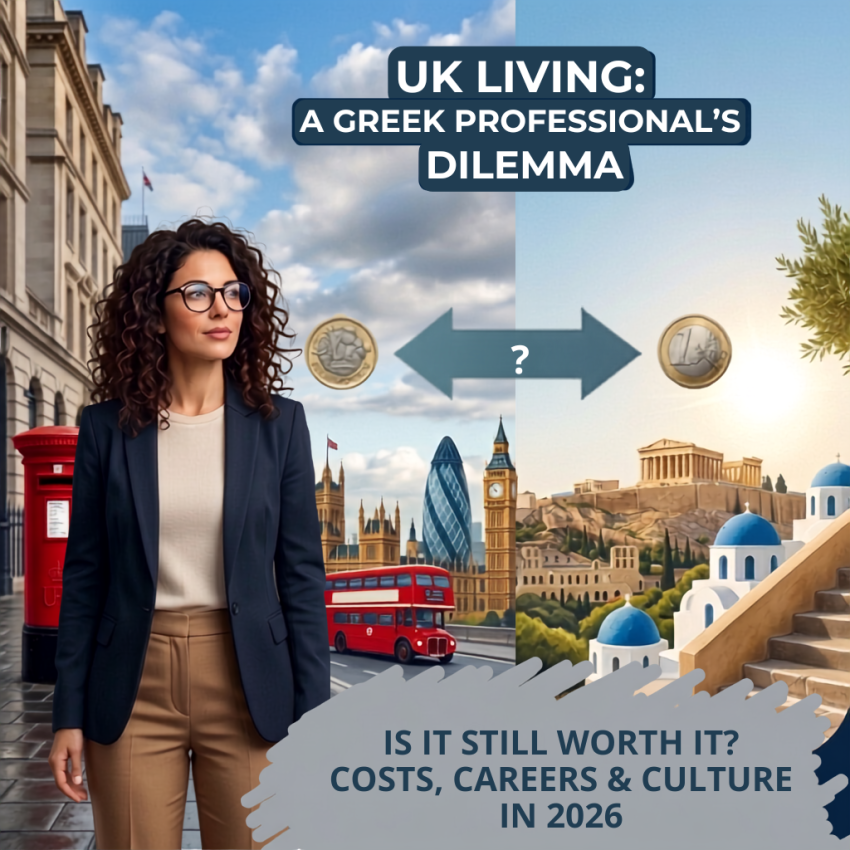
However, the economic landscape of 2026 presents a radically altered equation. Post-Brexit visa complexities, escalating living costs, and a restructured British tax environment have forced Greek expatriates to ask a fundamental question: Is living and working in the UK as a Greek professional immigrant still worth it?

To answer this, one must move past nostalgic perceptions and evaluate the pragmatic realities of contemporary British life—weighing soaring expenses against the professional mobility, earning potential, and lifestyle factors that define the migrant experience today.

The Financial Calculus: Navigating Post-2026 UK Living Costs

For any professional considering a move—or deciding whether to stay—the financial baseline has shifted dramatically. Understanding take-home pay versus non-negotiable living costs is essential for accurate budgeting.

Housing: The Primary Income Sink

Housing remains the single largest expense for immigrants in the UK. With average UK private rents reaching £1,366 nationally and prime city-centre locations demanding significantly higher premiums, rent frequently absorbs between 30% and 50% of a professional’s net income.

  • London: A one-bedroom flat in central zones ranges between £1,500 and £2,200 per month, while two-bedroom properties often exceed £2,800.
  • Regional Hubs (Manchester, Birmingham, Leeds): One-bedroom city-centre apartments generally range from £650 to £1,200, offering a substantial reduction in overhead without completely sacrificing career opportunities.

Beyond base rent, tenancy agreements require an upfront deposit equivalent to five weeks’ rent. Local taxation in the form of Council Tax adds an average of £144 per month (ranging from ~£1,200 for Band A to ~£2,000+ per year for Band D properties), depending on the borough and valuation band.

Utilities and Everyday Overhead

The days of cheap domestic energy in the UK are firmly in the past. Standard monthly utility and recurring commitments for a single professional or couple typically include:

  • Electricity & Gas: £50–£100 per month for a modest apartment; £150–£250 for larger properties.
  • Water Services: £30–£50 per month.
  • Connectivity (Broadband & Mobile): £35–£80 per month combined.
  • TV Licence: £159 annually (~£13/month), a legal requirement for live broadcasts and BBC iPlayer.
  • Groceries: £150–£250 monthly for a single adult, expanding to £400–£600 for a family of four.

Transportation and Mobility

Public transport remains the primary choice for urban professionals. While extensive, networks are costly. Intercity rail travel and city travelcards can demand £100 to £300 per month. Car ownership introduces fuel expenses (hovering around £1.40/litre, aided by extended fuel duty relief), annual vehicle tax (£165–£540), insurance (£500–£1,200+ annually for foreign drivers building UK credit history), and routine maintenance.

Income, Taxation, and Salary Realities

While the average UK monthly salary hovers around £5,940 (skewed by high-earning financial and tech sectors), a realistic entry-to-mid-level professional gross salary spans £35,000 to £60,000 depending on the field and location.

The UK operates a progressive tax system:

  • Personal Allowance: Up to £12,570 (0% tax).
  • Basic Rate (20%): £12,571 to £50,270.
  • Higher Rate (40%): £50,271 to £125,140.
  • National Insurance Contributions (NIC): An additional 12% on earnings between £12,570 and £50,270, and 2% above that threshold.
CategorySingle ProfessionalInternational StudentFamily of 4
Rent£800–£1,500£400–£900 (Shared/Halls)£1,200–£2,500
Utilities£120–£200£80–£150£250–£400
Groceries & Food£150–£250£120–£200£400–£600
Transport£100–£150£50–£100£200–£350
Council Tax£100–£200Exempt£200–£450
Miscellaneous£100–£200£80–£150£300–£500
Total Monthly Cost£1,370–£2,500£750–£1,500£2,550–£4,800

To clear basic expenses outside London, a single worker needs a minimum salary of £20,000–£25,000. However, to live comfortably, save, and maintain a reasonable standard of living, a single professional requires £30,000–£35,000+, while a family of four typically needs a combined household income of £45,000–£60,000.

The Greek Professional Perspective: Pros vs. Cons

Evaluating whether the UK remains an attractive destination requires looking beyond raw spreadsheets to compare the structural environments of Greece and the UK.

PROFESSIONAL ADVANTAGES
  • Structural Meritocracy & Fair Growth
  • High Salary Ceilings in Key Sectors
  • International Market Prestige
  • Vibrant Diaspora & Cultural Outlets
FINANCIAL & SYSTEMIC CHALLENGES
  • Soaring Housing & Utility Overhead
  • Post-Brexit Visa Friction & NHS Surcharge
  • Tax Traps & High Marginal Rates
  • Quality of Life / Weather Trade-offs

The Pros: Why Greeks Still stay to the UK?

  1. Meritocracy and Career Velocity: Unlike the often bureaucratic or network-dependent hiring processes in southern Europe, the UK corporate culture largely operates on merit, speed, and output. Professional advancement can happen rapidly for high performers.
  2. Salary Ceilings and Global Exposure: In sectors like fintech, biotechnology, corporate law, engineering, and specialized medicine, UK compensation ceilings remain significantly higher than in Greece. Experience gained in London or corporate regional centers carries immediate global capital.
  3. Infrastructure and Diaspora Support: Major UK cities feature established Greek communities, specialty supermarkets, direct flight connections to Athens and Thessaloniki, and active professional networks (e.g., Greek medical and academic societies in the UK).
  4. Access to Capital: For tech founders and entrepreneurs, the UK ecosystem provides access to venture capital, angel investors, and accelerator programs that dwarf most continental alternatives.

The Cons: The Friction Points

  1. The Post-Brexit Immigration Barrier: EU freedom of movement is gone. Greek professionals must secure a Skilled Worker visa, meet strict minimum salary thresholds, and pay heavy upfront fees—including the Immigration Health Surcharge (IHS)—which can total thousands of pounds before even setting foot in the country.
  2. The High-Cost, High-Tax “Squeeze”: Moving from basic rate to higher rate tax at £50,270 can feel punishing when paired with high local inflation, energy costs, and elevated rents. The ability to build significant cash savings quickly has diminished compared to a decade ago.
  3. Work-Life Balance and Climate: The trade-off between the Mediterranean lifestyle, natural light, and relaxed social rhythms versus the fast-paced, weather-challenged UK urban lifestyle remains a permanent psychological factor for Greek expatriates.
  4. Property Ownership Hurdles: While homeownership among native UK residents sits higher, only ~43% of foreign-born residents own their homes (dropping to under 20% for recent arrivals). High property prices (£270k–£300k UK average, much higher in the South) and strict mortgage stress-testing make stepping onto the property ladder difficult without significant capital brought from abroad.

The Verdict: Is It Still Worth It?

The UK is no longer an effortless, automatic choice for every Greek graduate. The era of moving casually on a low wage to “figure things out” has effectively ended due to immigration rules and living costs.

However, for qualified professionals, specialists, and ambitious careerists, the UK remains overwhelmingly worth it under specific conditions:

  • It IS worth it if: You are in a high-demand sector (medicine, software engineering, finance, specialized consultancy), qualify comfortably for a Skilled Worker visa, earn above the national median (£35k+ starting, with a clear path to £50k+), and view the UK as a 3-to-7-year accelerator for your international career or capital accumulation.
  • It IS NOT worth it if: Your expected salary sits near minimum visa thresholds in high-cost areas like London, or if your primary goal is immediate property acquisition and an outdoor-centric lifestyle without a substantial financial cushion.

Succeeding as a Greek professional immigrant in the UK today requires strategic planning. Choosing the right city, negotiating visa sponsorship terms carefully, understanding net tax outcomes, and maintaining a solid 3-to-6-month emergency fund (£5,000–£10,000 for singles) are the pillars that transform a UK move from a financial struggle into a life-changing career move.

Brexit's Impact on Greeks in UK

Re-Evaluating the British Dream: How Brexit Redefined the Lives and Economic Prospects of Greeks in the UK

Posted on 6 August 202610 August 2026 by Editor

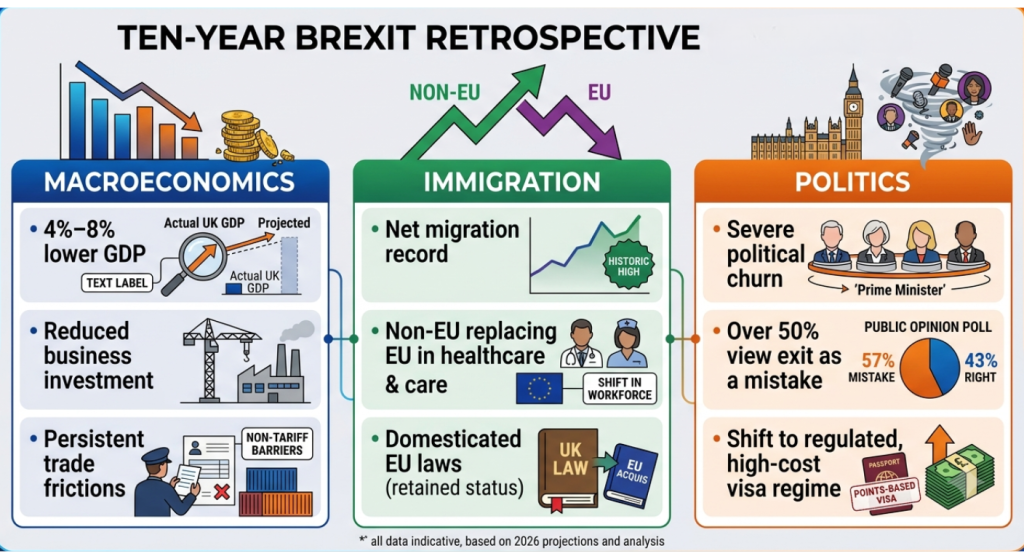
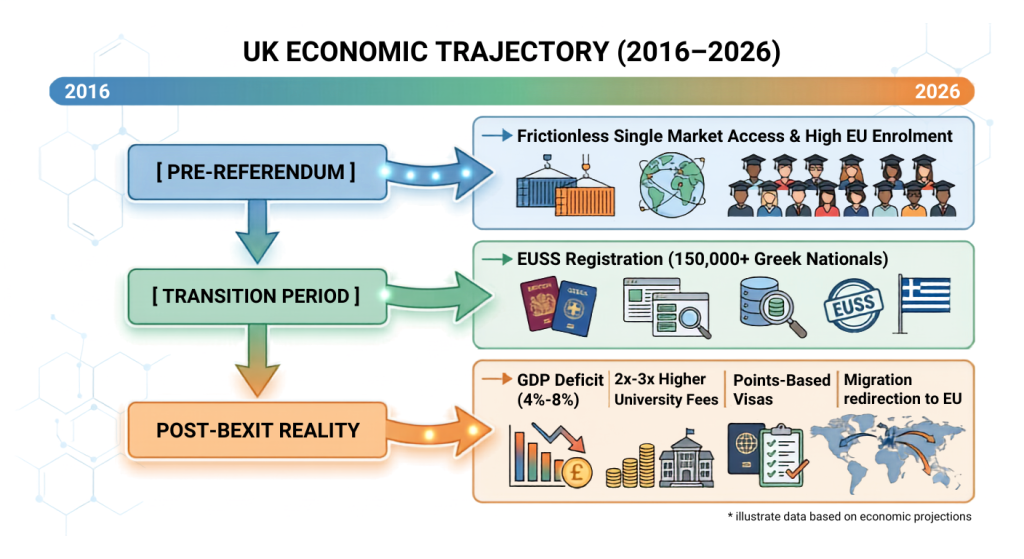
Ten years after the historic June 2016 referendum, consensus analysis demonstrates that Brexit did not trigger a sudden economic collapse, but it has acted as a persistent drag on the UK economy. A decade of empirical data confirms that Britain’s exit from the European Union fundamentally restructured its global posture, trade dynamics, domestic labour market, and socio-political landscape. Most economic studies indicate that UK GDP per capita is roughly 4% to 8% lower than it would have been had the nation remained inside the single market, accompanied by diminished business investment and severe, ongoing trade friction.

While macroeconomic figures summarise national productivity losses, the real story lies in the structural friction introduced into British economic and social systems. Ending free movement—the core pillar of EU integration – reconfigured the foreign-born workforce, restricted labour supply across vital sectors, and established a complex, high-cost visa apparatus.

To fully appreciate this ten-year milestone, one must examine both macro-level economic realities and specific micro-level human mobility patterns, particularly through the lens of long-standing diaspora communities such as the UK’s Greek population.

The Macroeconomic Footprint

1. Trade and Exports

Departure from the EU Customs Union and Single Market introduced an array of non-tariff barriers, border checks, and administrative red tape. Whilst the UK avoided catastrophic tariffs through the Trade and Cooperation Agreement (TCA), border inspections, rules-of-origin paperwork, and regulatory divergence significantly reduced both the variety and volume of goods exported to European markets. Small and medium-sized enterprises (SMEs) bore the brunt of this transition, with many opting out of exporting to the EU entirely due to prohibitive compliance costs.

2. Investment and Productivity

Business investment in the UK stalled significantly following the 2016 vote and has lagged behind comparable G7 economies ever since. This prolonged stagnation in capital expenditure directly stifled national productivity growth. UK businesses, forced to allocate capital towards Brexit compliance, legal auditing, and supply chain restructuring, diverted funds away from domestic research, development, and technological modernisation.

3. Growth and Economic Output

The immediate recession predicted by some campaign forecasts in 2016 failed to materialise; however, the long-term reality has proven to be a slow-burning erosion of capacity. Sub-par growth rates over the past decade mean that tax revenues remain squeezed, public services are under sustained funding pressure, and household incomes have stagnated compared to international peers.

The Greek Diaspora

The human and societal costs of post-Brexit border regimes are starkly illustrated by the Greek experience in the UK – a demographic that exemplifies how mobility restrictions alter human capital, corporate recruitment, and community identity.

1. Context: The “Brain Drain” Generation

Following the 2008 global financial crisis and the sovereign debt emergency that brought Greece to fiscal collapse, an estimated 500,000 Greeks emigrated between 2009 and 2019. Unlike mid-20th-century migration waves dominated by manual labour, this exodus was highly educated. Young doctors, engineers, researchers, computer scientists, and financial analysts departed Greece in large numbers.

Britain emerged as the primary destination for this skilled workforce due to three key factors:

  • Deep Educational Ties: A long history of Greek students attending UK universities established active academic and professional networks.
  • Language Proficiency: Widespread English-language fluency among young Greeks significantly lowered barriers to integration.
  • Flexible Labour Markets: The City of London, the National Health Service (NHS), and Russell Group universities offered rapid career progression in contrast to Greece’s austerity-bound public and private sectors.

Greek medical professionals quickly populated NHS hospital wards, academics became one of the largest non-British EU faculty contingents in higher education, and quantitative analysts filled key roles across London’s financial district. By the time the UK launched the EU Settlement Scheme (EUSS), over 150,000 Greek nationals had applied for Settled or Pre-Settled status.

2. The Legal Paradigm Shift

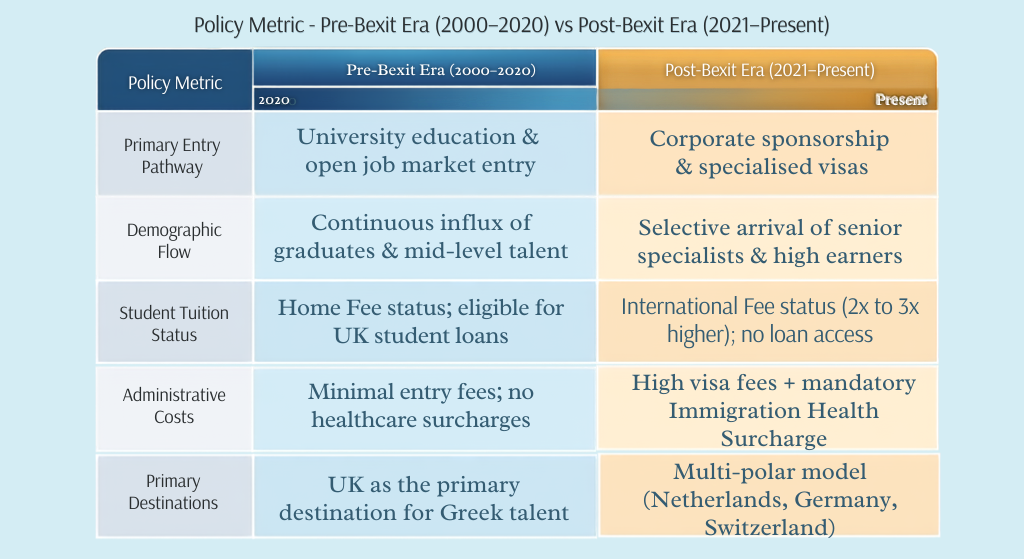
The implementation of the UK points-based immigration system in January 2021 dismantled this open-ended corridor. EU citizens lost their automatic right to live, work, and study in the UK, bringing them under administrative constraints previously reserved for non-EU foreign nationals.

3. Structural Impacts on Diaspora Sectors

Higher Education Pipeline Disruption

The most dramatic impact occurred in academia. Prior to 2021, Greek undergraduates paid identical “Home” tuition fees as domestic British students and held access to UK student loans. Reclassification to international student status doubled or tripled tuition costs, whilst the removal of loan eligibility mandated upfront self-funding. Higher Education Statistics Agency (HESA) data subsequently showed one of the steepest enrolment drops among Greek students compared to all other EU member states, permanently narrowing the incoming talent pipeline.

Corporate and Services Friction

Whilst major financial institutions and NHS trusts retain the capital to sponsor Skilled Worker Visas for senior specialists, entry-level and mid-tier roles have largely closed to foreign-born candidates without existing work authorisation. SMEs in specialised engineering, tech, and architecture frequently pass on hiring non-resident Greeks to avoid Home Office sponsorship paperwork and fees.

Similarly, Greek hospitality ventures, food importers, and cultural enterprises – reliant on short-term EU labour – faced severe staffing shortages due to visa salary thresholds, forcing many to contract operational hours or raise prices.

Alternative Hubs and the “Brain Gain” Reverse Flow

The restrictive post-Brexit UK market accelerated two parallel trends in continental Europe and Greece:

1. The Rise of European Competitors

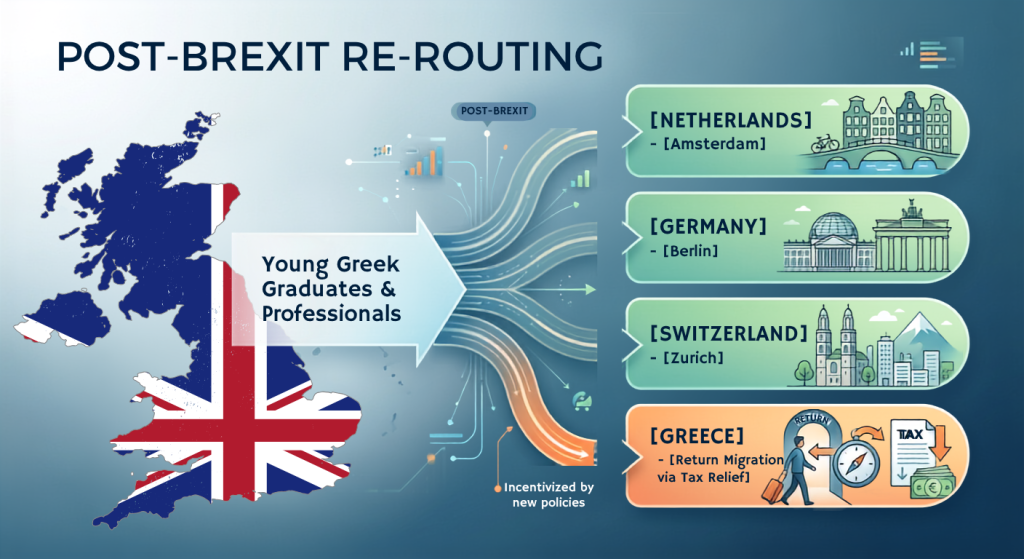
Ambitious young Greeks have increasingly redirected their mobility towards continental European hubs that operate extensively in English. Cities like Amsterdam, Berlin, Dublin, Copenhagen, and Zurich present clear comparative advantages:

  • Unrestricted access under EU freedom of movement laws.
  • Elimination of visa fees, sponsorship mandates, and healthcare surcharges.
  • Dynamic tech sectors and heavily subsidised university tuition.

As a result, London’s decades-long position as the primary foreign hub for Greek graduates has fragmented into a multi-polar European distribution.

2. Economic Recovery in Greece and Tax Incentives

Simultaneously, Greece’s broader economic recovery over the past decade transformed domestic prospects. Sustained GDP growth, infrastructure modernisations, and large-scale foreign direct investment created viable local career opportunities. To capitalise on this, the Greek government introduced targeted measures to draw skilled labour back:

  • 50% Income Tax Exemption: A seven-year tax relief program for professionals and self-employed individuals relocating their tax residence back to Greece.
  • Remote Work Flexibility: Expanding remote options enabled many UK-settled Greeks to retain international roles whilst living in Greece.
  • Regional Innovation Hubs: Investment in technology infrastructure across Athens and Thessaloniki established high-value positions that did not exist during the sovereign debt crisis.

For many who relocated to the UK between 2010 and 2015, Brexit acted as the catalyst to end their British tenure, driving a notable return flow of human capital to Greece.

Immigration, Politics, and Public Opinion

Beyond structural economic effects and diaspora realignments, the broader societal implications of Brexit over the past decade reflect profound political transformation across the UK.

1. Migration Shifts and Border Control

Whilst ending free movement curtailed European migration, overall UK net migration climbed to historic highs over the decade following the vote. To address acute labour shortages in healthcare, social care, and services, successive UK administrations expanded non-EU recruitment. Consequently, migration shifted from predominantly European, low-friction movement to heavily regulated international immigration from non-EU nations.

On border control, sovereignty over domestic lawmaking was formally reclaimed. However, rather than undergoing radical deregulation, much of the pre-existing body of EU regulation was simply domesticated into UK statutes to maintain operational continuity and prevent legal ambiguity.

2. Political Instability and Public Sentiment

The decade following the 2016 vote was marked by severe political instability, characterised by frequent changes in government leadership, parliamentary deadlocks, and persistent policy adjustments.

Ten years post-referendum, public sentiment reflects broad disappointment with how the departure was executed:

Economic Realisation: Frustration is fueled by the absence of promised economic windfalls, alongside tangible cost-of-living pressures and visible staffing shortages across public infrastructure.

Polling Realities: Clear majorities in recent surveys reflect public disappointment, with over half of the population viewing the departure as a mistake.

A Stratified Future

A decade after the 2016 referendum, the evidence confirms that Brexit reshaped the British economy not through a single catastrophic event, but through a steady, long-term reduction in potential growth, trade capacity, and international competitiveness.

For international talent – exemplified by the Greek diaspora – the UK has shifted from an open, low-friction market into a selective, highly regulated space. Britain remains an important hub for settled EU nationals anchored by the EUSS. However, the era of effortless mobility – where a graduate could move to London and build a career without institutional friction – has ended, replaced by strict visa thresholds, complex sponsorship rules, and a competitive landscape spanning continental Europe.

Lessons on Living a Meaningful Life: Perspectives from Greeks in Britain

Posted on 8 December 20248 December 2024 by Editor

Living a meaningful life is an aspiration shared by people worldwide, including the Greek community in Britain. The concept blends personal satisfaction with the broader impact of one’s actions, creating a sense of fulfilment that extends beyond oneself. For Greeks living in the UK, balancing cultural heritage with life in a new environment adds a unique dimension to this pursuit. Exploring the intersection of personal and collective purpose within this context offers valuable insights into leading a purposeful and enriched life.

Understanding Meaning in Life

The “meaning of life” sparks philosophical curiosity, but a more tangible approach focuses on “meaning in life.” This distinction becomes especially significant for Greeks adapting to British culture. Purpose, coherence, and significance—the three pillars of meaningful living—allow individuals to navigate these two identities effectively. For instance, purpose drives long-term goals, coherence helps integrate Greek heritage with British societal norms, and significance reinforces the value of one’s cultural identity.

These elements are crucial for mental and physical health. For Greeks maintaining a strong connection to their roots, these cultural ties often foster resilience and provide a sense of belonging. Participating in cultural traditions, celebrating festivals, or simply sharing Mediterranean hospitality with British friends can serve as meaningful acts that contribute to personal and societal well-being.

Relationships as Foundations of Meaning

Strong interpersonal connections are at the heart of a meaningful life, a principle echoed across cultures. The renowned Harvard Study of Adult Development reveals relationships as a cornerstone of happiness and health, a finding highly relevant for Greeks in Britain. Greek culture, deeply rooted in family and community bonds, emphasizes the value of close-knit relationships.

For Greeks navigating British society, maintaining traditional ties while forming new connections enriches their experience. Local Greek organizations, churches, and cultural events provide a space to nurture relationships, blending familiar customs with the diversity of Britain’s multicultural fabric. These connections are not only a source of emotional support but also act as a bridge between cultures, fostering mutual understanding and respect.

Personal Fulfilment and Community Contribution

Balancing individual goals with community impact is essential for a meaningful life. Many Greeks in Britain find personal fulfilment through careers, creative pursuits, or education, while also contributing to their local communities. Whether through volunteering, teaching, or sharing culinary traditions, these acts of service amplify life’s meaning.

Greek-British parents, for instance, often blend their cultural values into their children’s upbringing, ensuring that traditions like storytelling or cooking are passed down. This dual approach creates a legacy that honours their heritage while enriching British society. In this way, personal joy and collective significance intertwine, creating a life imbued with purpose.

Navigating Challenges with Authenticity

Adapting to a new country can present challenges, from cultural adjustments to feelings of isolation. For Greeks, the solution often lies in embracing their identity while remaining open to new experiences. Modern life may prioritise material success, but Greeks living in Britain often find deeper meaning through their strong familial and cultural connections.

Building meaningful relationships, celebrating Greek holidays, or attending local events like Greek Food Festivals are practical steps toward creating a fulfilling life. Additionally, reflecting on values and goals can help align one’s actions with a sense of purpose, whether it’s staying true to traditions or forging new paths in a diverse society.

A Call to Purposeful Living

For Greeks in Britain, living a meaningful life is a journey of blending authenticity with adaptation. The act of staying true to cultural roots while engaging with British society creates a dual sense of identity that enriches both personal and collective experiences.

Strong relationships, intentional actions, and a commitment to cultural heritage serve as guiding principles. By embracing these values, Greeks in Britain not only enrich their own lives but also contribute to the broader tapestry of multicultural Britain. Oscar Wilde’s timeless advice, “Be yourself; everyone else is already taken,” holds particular relevance here. Authenticity, paired with purpose, ensures that life remains both meaningful and impactful.

The Positives of Parenting in the United Kingdom

Posted on 29 November 202429 November 2024 by Editor

Parenting in the UK offers families a unique blend of benefits that make it an appealing place to raise children. From world-class education to rich cultural experiences, the UK provides an environment that supports both parents and children in thriving together.

High-Quality Education System

The UK boasts a globally respected education system, offering a mix of public, private, and international schools. Schools often emphasise inclusivity and creativity, ensuring children receive a well-rounded education while being supported in their unique talents and needs.

Abundant Green Spaces

Despite its urban areas, the UK is dotted with parks and countryside, providing families with ample opportunities for outdoor recreation. National parks, local playgrounds, and city gardens encourage children to explore nature while offering parents a peaceful retreat from busy routines.

Rich Cultural Heritage

The UK’s history and culture provide endless opportunities for educational family outings. Museums, castles, galleries, and theatres often host interactive exhibits and workshops that inspire children’s curiosity and creativity. Annual events, like literary festivals and seasonal fairs, ensure there’s always something for families to enjoy.

Strong Community Support

From parenting groups to playdates, local communities in the UK offer robust networks for families. These connections help parents find advice, support, and companionship while giving children opportunities to socialise and build friendships.

Access to Excellent Healthcare

The National Health Service (NHS) provides free healthcare for families, ensuring access to paediatricians and specialists. This system gives parents peace of mind, knowing their children’s medical needs will be met without financial strain.

Exposure to Diversity

The UK’s multicultural society is a significant advantage for families, exposing children to a range of cultures, languages, and traditions. This environment fosters empathy, open-mindedness, and a global perspective, equipping children with essential values for today’s world.

Opportunities for Personal Growth

Parenting in the UK encourages children to develop independence through access to extracurricular activities, public transport, and diverse social settings. These experiences nurture confidence, problem-solving skills, and resilience.

Raising children in the UK offers families an enriching journey, blending tradition, education, and modern amenities. It’s a place where children can grow into well-rounded individuals while families create lasting memories together.

Living-in-Britain-as-a-Foreigner

Living in Britain as a Foreigner: The Balance of Authenticity and Adaptation

Posted on 25 November 202425 November 2024 by Editor

Moving to Britain is a transformative experience that brings a mix of excitement, challenges, and opportunities. For many foreigners, the transition involves not only adapting to a new way of life but also finding ways to maintain their sense of self. Britain’s multicultural society is one of its greatest strengths, but it also presents a unique cultural landscape where the desire to “fit in” can sometimes clash with the goal of staying true to one’s roots.

Oscar Wilde’s famous words, “Be yourself; everyone else is already taken,” provide a poignant reminder for those navigating the complexities of life in a new country. This quote serves as a guiding principle for embracing authenticity while adapting to the norms and expectations of British society.

The Initial Adjustment

When newcomers arrive in Britain, it’s natural to feel a sense of curiosity mixed with apprehension. From the famous British politeness to the love of tea and discussions about the weather, cultural norms can be both fascinating and intimidating. Many foreigners feel the urge to adjust aspects of their behaviour, interests, or even accents to blend in with their new surroundings. This adaptation is often seen as a way to gain acceptance and avoid standing out.

However, the pressure to conform can sometimes lead to a sense of losing touch with one’s identity. While it’s important to respect and understand local customs, it’s equally vital to remember that authenticity plays a key role in creating meaningful connections. By staying true to your own values and cultural heritage, you not only enrich your personal experience but also contribute to the diversity of the community you’re joining.

Embracing Multiculturalism

One of Britain’s most defining features is its multiculturalism. Cities like London, Manchester, and Birmingham are melting pots of different cultures, where people from all over the world live and work together. This diversity creates an environment where various traditions, cuisines, and languages coexist, offering newcomers a unique opportunity to both integrate and share their own culture.

For many foreigners, this multicultural landscape is a source of comfort. It provides a space where they can celebrate their heritage without fear of judgment or exclusion. By participating in cultural exchanges—whether through food, festivals, or storytelling—foreigners enrich their local communities and build bridges of mutual respect and understanding.

Balancing Adaptation and Authenticity

Finding a balance between adapting to British culture and maintaining one’s identity is key to a successful transition. Integration doesn’t have to mean assimilation. Instead, it can involve learning about British customs and traditions while proudly sharing your own. For instance, participating in British traditions like afternoon tea or Bonfire Night can be a great way to connect with others, while also introducing your neighbours or colleagues to your own customs and celebrations.

Many foreigners have found that this balance not only helps them feel more at home but also strengthens their sense of identity. By staying true to their roots, they gain a deeper appreciation for their own culture while developing a genuine connection with the people around them. This approach fosters a sense of belonging that goes beyond mere acceptance, allowing them to feel valued for who they are.

The Role of Community

Community plays a crucial role in helping newcomers navigate life in Britain. Whether it’s joining local cultural associations, attending events, or connecting with others from a similar background, having a support network can make all the difference. These communities offer a safe space to share experiences, seek advice, and celebrate cultural traditions.

For example, Greek and Cypriot communities in the UK often host events that showcase their rich heritage, from traditional dance performances to food festivals. These gatherings not only provide a sense of familiarity but also allow members to introduce their culture to others, fostering a spirit of inclusivity and mutual appreciation.

Overcoming Challenges

While the journey of living in Britain as a foreigner is rewarding, it’s not without its challenges. Homesickness, cultural misunderstandings, and navigating the complexities of immigration policies can all add to the stress of adjusting to a new life. However, these challenges also offer opportunities for growth.

By approaching these difficulties with an open mind and a willingness to learn, many foreigners find that they become more resilient and adaptable. Over time, they develop a deeper understanding of themselves and the world around them, turning what initially felt like obstacles into valuable life lessons.

Celebrating Diversity

In essence, living in Britain as a foreigner is a journey of self-discovery and cultural exchange. It’s about finding ways to honour your heritage while embracing the opportunities that come with being part of a diverse and dynamic society. By remaining authentic, you not only enrich your own experience but also contribute to the vibrant tapestry of life in Britain.

Oscar Wilde’s timeless advice reminds us that authenticity is the key to navigating differences with confidence and grace. In a world that often emphasises conformity, being true to yourself is a powerful way to foster connections, build understanding, and leave a meaningful impact on the community around you.

Through this balance of adaptation and authenticity, foreigners can transform their experience in Britain from a challenge into an enriching and fulfilling chapter of their lives. Whether it’s through sharing traditions, forging new relationships, or simply staying true to their values, each individual’s unique journey adds to the beauty of Britain’s multicultural society.

Conclusion

Living in Britain as a foreigner offers a wealth of opportunities to grow, learn, and connect. By embracing authenticity and celebrating diversity, newcomers can create a sense of belonging while leaving a positive mark on their communities. The journey may not always be easy, but it’s one that ultimately leads to a richer and more fulfilling life.

Remaining true to oneself is the foundation of this experience, ensuring that each individual’s unique voice is heard, valued, and celebrated. In doing so, foreigners don’t just adapt to British society—they actively shape it, making it a better, more inclusive place for everyone.

Dealing with Homesickness: Tips for Feeling at Home in the UK

Posted on 6 November 20244 November 2024 by Editor

Homesickness is a common feeling when you’re settling into a new place, especially one as distinct as the UK, with its unique culture, pace, and climate. While adjusting can take time, there are practical steps you can take to ease the transition and make your new environment feel a bit more like home. Here are some helpful tips for managing homesickness and finding comfort as you settle in.

1. Seek Out Familiar Community and Culture

One of the best ways to feel more at home is to connect with others who understand what you’re going through. Local groups like the Society of Greeks and Cypriots in the UK provide a valuable space for shared experiences, where you can connect with people from similar backgrounds. Participating in meet-ups or attending events allows you to immerse yourself in familiar conversations, food, and traditions, offering comfort and connection.

2. Build a Routine that Includes Comforts from Home

Having a daily routine can create stability and help you feel more grounded in your new surroundings. Incorporate elements from home into your daily life—whether it’s enjoying a cup of Greek coffee in the morning, reading your favorite news sources from home, or calling loved ones regularly. These simple rituals can offer a comforting sense of familiarity as you adjust.

3. Create a Cozy, Personalized Space

Making your living space feel like home is essential when adjusting to a new country. Decorate with items that remind you of home, like photos, souvenirs, or a favorite blanket. Lighting candles with scents that bring back memories or playing music from home can help make your space feel cozier and more personal. A comfortable and welcoming home base gives you a place to relax and unwind when homesickness hits.

4. Explore Local Markets and Specialty Shops

A taste of home can make a big difference. Many local markets and international grocery stores carry ingredients that might remind you of home, allowing you to cook familiar meals and enjoy flavors from your culture. Finding a favorite Greek bakery, market, or restaurant can be a great source of comfort and make you feel more connected to your roots, even far from home.

5. Rediscover Old Hobbies and Try New Ones

Engaging in hobbies can be a great way to take your mind off homesickness and begin to enjoy your new surroundings. Seek out local sports clubs, craft workshops, or classes that interest you. Rediscovering old hobbies or picking up new ones is also a wonderful way to meet people with similar interests and develop friendships. As you spend more time doing things you enjoy, you may find yourself feeling more connected and comfortable.

6. Give Yourself Time and Be Patient

Homesickness is a natural part of the relocation process, and it’s okay to feel a range of emotions as you settle in. The initial months in a new place can be challenging, but it’s important to give yourself time to adjust. Remember that homesickness usually eases as you begin to feel more comfortable in your surroundings and form new memories. Take things one day at a time, focusing on the small moments that bring you joy.

7. Embrace New Experiences While Honoring Your Roots

While homesickness may have you reminiscing about home, exploring your new city can be equally rewarding. The UK offers a wealth of new experiences, from its historic landmarks to scenic parks and cultural festivals. Embracing these moments while honoring your own traditions allows you to find a balance between the old and the new. Over time, you may find yourself creating new traditions and enjoying what both cultures offer.

Finding Balance and Feeling at Home

Homesickness may be a temporary phase, but it’s also an opportunity to grow and explore your resilience. Finding a blend of familiarity and adventure can help make life in the UK enjoyable and fulfilling. As you build routines, friendships, and memories, your new surroundings will start to feel like home. With time and patience, the UK can become a place where you feel at ease, enriched by both the connections you maintain with home and the new experiences you embrace.

What are the challenges of living in the UK as a Greek?

Posted on 4 November 20245 August 2026 by Editor

Living in the UK offers exciting opportunities and experiences for many Greeks, but it also presents unique challenges. Adapting to a new culture, climate and way of life can sometimes seem overwhelming, especially when it is in sharp contrast with what is familiar in their country of origin. Here are some of the common difficulties Greeks face when living in the UK.

1. Weather and lack of sun

One of the most immediate changes Greeks notice when they move to the UK is the weather. The UK is known for its long winters, cloudy skies and frequent rain, which can be a stark contrast to the sunny climate of Greece and Cyprus. Many Greeks miss the clear blue skies and warmth of the Mediterranean, as the gloomy weather can affect mood and energy, especially during the winter months. Seasonal Affective Disorder (SAD) is quite common, making life difficult for those who are used to the sun most of the year.

2. Cultural differences and social dynamics

Cultural change can also be difficult. Greeks are used to a warm and communal approach to socialising, with a strong emphasis on family, close friendships and spontaneous encounters. In contrast, social interaction in the UK can sometimes seem more reserved and structured. This change can make it harder to form close friendships and build a social network, leading to feelings of isolation or homesickness for many Greeks. Adapt to a more individualistic culture where people can be less likely to join spontaneously, it can be a source of isolation.

3. High cost of living, especially in London

The cost of living in Great Britain, especially in cities like London, is significantly higher than in Greece. Rent, utilities and groceries are often more expensive, putting a strain on finances. This economic contrast can make it more difficult to enjoy the lifestyle many are used to in Greece and Cyprus, where socializing and dining are generally more affordable. This arrangement could cause budget difficulties and force the Greeks to change their habits and lifestyles in a way that seems restrictive.

4. Limited access to traditional Greek cuisine

For many Greeks, food is central to their daily lives and cultural identity. So, it can be difficult to find familiar Greek ingredients and dishes in the UK. Although there are some Greek shops in the big cities, traditional ingredients and dishes can be hard to find or expensive. Many Greeks miss the convenience of fresh local produce and Greek specialties and traditional flavours which are often more accessible and accessible at home. This lack can make it difficult to keep culinary traditions alive and maintain a connection to Greek culture through food.

5. Language and communication barrier

Although English is widely spoken in Greece, language difficulties can arise, especially for those who are not yet fluent. The nuances of British English, regional accents and cultural slang can make communication a bit tricky at first. For some Greeks, this language adjustment can result in feeling awkward or hesitant when participating in conversations, especially in a professional context. Also, language differences can sometimes contribute to misunderstandings, especially when the indirect British style of communication conflicts with the more direct style of communication that many Greeks are used to.

6. Differences between health care and bureaucracy

The health care system in the UK, although accessible, may seem very different from the health care experience in Greece. Waiting times for non-urgent matters in the NHS can be long and navigating the system can seem unusual. Some Greeks may find it difficult to adapt to the UK approach to healthcare, especially when they are used to a more immediate and direct form of medical care. In addition, the bureaucratic processes in the UK for things like registering with a GP, visa applications and other administrative matters can seem complex, adding stress to the adjustment period.

7. Homesickness and distance from family

Being away from family is one of the most common challenges Greeks face when living abroad. Greek culture places great importance on family ties, and the feeling of separation can be difficult to cope with, especially during traditional holidays or family events. While technology makes it easier to maintain connections, distance can also lead to feelings of nostalgia and longing for the warmth and closeness of family so central to Greek culture.

8. A different pace of life and work culture

The work culture and pace of life in the UK may also seem different. Many Greeks are used to a more relaxed approach to life, where work-life balance is highly valued and leisure is paramount. In contrast, UK work culture often seems faster, with longer working hours and a greater emphasis on productivity. This change can take time to adjust to, especially for those who are used to the slower and more family-oriented lifestyle typical of Greece and Cyprus.

9. Lack of spontaneity and sense of community

In Greece and Cyprus, it is common to see people enjoying spontaneous social interaction, with a close sense of neighbourhood community. In the UK, people often prefer to plan social events in advance and the sense of community can be less present, especially in larger cities. The change can be disorienting for Greeks who enjoy an open-door culture and the warmth of small-town life, where people know each other well and often mingle unplanned.

—

Finding the balance between two worlds

While there are certainly challenges to living in the UK as a Greek, many Greeks learn to balance these differences by finding local communities, establishing familiar routines and staying connected to their roots. Embracing both cultures allows the Greeks to discover the richness of their heritage as they adapt to a new environment, mixing the best of both worlds in a way that can ultimately be enriching. Over time, these challenges often lead to growth, adaptability and self-appreciation unique qualities that both countries offer.

Is Living in London Worth It? A Comprehensive Guide

Posted on 1 November 20244 November 2024 by Editor

The Masters of Living in London

1. Vast Open doors for Work and Development

London is a worldwide centre point for some businesses, from money to innovation, media, and human expression. Individuals run to the city for vocation development and expert systems administration, and the potential for progression is one of the top reasons individuals choose to make the city their home. Many find that functioning in London offers special open doors and encounters they wouldn’t find somewhere else, with a portion of the world’s top organizations, new businesses, and social foundations extremely close to home.

2. Social Wealth and Variety

One of London’s most praised characteristics is its multicultural climate. From food markets and celebrations to theatres and unrecorded music, the city has something for everybody, paying little mind to where they come from. London is much of the time portrayed as where the entire world meets up, and residents get to encounter a scope of societies, dialects, and foods in a solitary city. This variety makes it simple to track down networks and associate with individuals from various foundations.

3. Unequalled Admittance to Expressions, History, and Diversion

London is a fantasy for history buffs, craftsmanship sweethearts, and theatregoers. The city is home to a-list exhibition halls, noteworthy locales, theatres, and music settings. A significant number of these, similar to the English Historical centre and the Tate Present day, offer free passage, permitting residents to investigate craftsmanship and history without burning through every last pound. Whether it’s a night out in Soho, getting a West End show, or going to a show, the social choices are practically unending.

4. Extraordinary Public Transport

While getting around London can be a cycle overwhelming from the outset, the public transport framework is broad and by and large dependable. The Underground, transports, and trains make it conceivable to traverse the city rapidly and generally moderately, particularly contrasted with driving. Numerous residents feature that the comfort of public transportation makes it simpler to investigate various pieces of the city without requiring a vehicle.

The Cons of Living in London

1. The Significant expense of Living

London’s cost for many everyday items is famously high, and for some inhabitants, this is a critical disadvantage. Lease and property costs specifically can eye-water, with even unobtrusive pads costing an enormous part of month to month pay. Food, feasting out, and move expenses can likewise add up. A huge number wind up planning cautiously or selecting to share lodging to get by.

2. The Occupied, Speedy Way of life

London’s speedy way of life can be both thrilling and debilitating. Numerous residents report that while they love the energy of the city, they additionally experience burnout from the steady buzzing about. Long working hours and occupied drives can allow for unwinding, and feeling overpowered by the city’s consistent activity is simple.

3. The Test of Tracking down Local area

In spite of London’s size and variety, certain individuals find it trying to fabricate a feeling of local area, particularly when contrasted with more modest towns or urban communities. The city’s transient nature, with many individuals moving in and out, can make it hard to shape enduring connections. In any case, numerous residents in the end track down their specialty by joining clubs, going to occasions, or associating through work or leisure activities.

4. The Climate

The English weather conditions is a notorious part of living in London that numerous residents notice as a drawback. The city’s continuous downpour and dark skies can influence individuals’ states of mind, particularly during the long winters. While there are numerous ways of capitalizing on the seasons, the weather conditions can be a shock to the individuals who are utilized to hotter, sunnier environments.

Things being what they are, Is It Worth The effort?

At last, whether living in London is worth the effort relies upon individual needs. For those looking for vocation development, social encounters, and a lively metropolitan way of life, London offers potential open doors that are difficult to coordinate. Be that as it may, it’s vital to gauge these against the significant expense of living, the bustling speed, and different difficulties.

Certain individuals track down an equilibrium that works by residing in calmer areas or even right external the city, where they can get to the advantages of London without being overpowered by its power. Others blossom with the city’s high speed, tracking down that the aces — like open positions, culture, and social assortment — offset the disadvantages.

For some, the key is going into it with practical assumptions and an arrangement to capitalize on what London offers while dealing with the inescapable difficulties. Whether you’re attracted to London for its proficient open doors, social allure, or worldwide associations, the city is an encounter that, by and large, is certainly worth difficult no less than once.

SELECT LANGUAGE

Community Events

Proud Supporters of the UK Greek Community!

We’re dedicated to backing every Greek charity and community group across the UK by bringing maximum visibility to your events.

Tell us about your upcoming event and let’s share it with Greeks all over the country!

Of course, featuring your event is completely free!

Find Out More

List Your Event

Follow Us

About

  • Our Story
  • Website Terms of Use
  • Privacy Policy

Travel Services

  • Travel Booking Conditions & Financial Protection
  • The Travel Advisor service
  • Personalised Travel Itineraries

Communication

Join Our Newsletter

Get in touch with us

©2026 Greeks in UK

Powered by
►
Necessary cookies enable essential site features like secure log-ins and consent preference adjustments. They do not store personal data.
None
►
Functional cookies support features like content sharing on social media, collecting feedback, and enabling third-party tools.
None
►
Analytical cookies track visitor interactions, providing insights on metrics like visitor count, bounce rate, and traffic sources.
None
►
Advertisement cookies deliver personalized ads based on your previous visits and analyze the effectiveness of ad campaigns.
None
►
Unclassified cookies are cookies that we are in the process of classifying, together with the providers of individual cookies.
None
Powered by